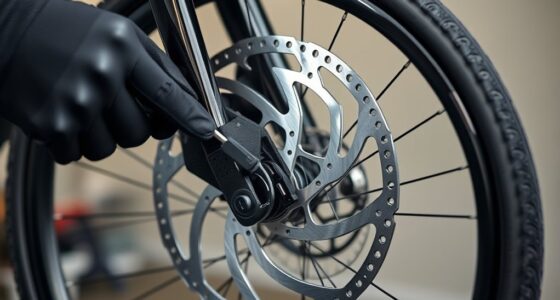
To find a neutral start for saddle height and setback, begin by setting your saddle so that at the pedal’s bottom, your knee is slightly bent around 25-35°, ensuring full leg extension without overreaching. Confirm your saddle is positioned so your knee aligns over the pedal’s center when the crank is at 3 o’clock. Adjustments based on comfort and performance will help you optimize your ride. Keep exploring to discover more tips for setting up your bike perfectly.

Get your wardrobe favorites delivered free with Prime
- Fast, free delivery on millions of items
- Prime Video, Amazon Music and more included
- Member-only deals all year
Key Takeaways
- Adjust saddle height so your knee is slightly bent (~25-35°) at the pedal’s lowest point for optimal power and comfort.
- Ensure your saddle setback positions your knee over the pedal’s center at 3 o’clock for proper ergonomics.
- Test saddle position during rides, making small adjustments based on comfort, pedal stroke smoothness, and efficiency.
- Set your saddle height and setback to maintain a balanced posture, reducing strain on knees, hips, and lower back.
- Proper saddle placement promotes even weight distribution, stability, and longer, more comfortable cycling sessions.

Setting your saddle height and setback correctly is crucial for comfort, efficiency, and injury prevention while cycling. When you focus on a proper bike fit, you ensure that your saddle position supports ideal ergonomic positioning. This means your body aligns naturally with the bike, reducing strain on muscles and joints, and helping you ride longer and more comfortably. The right saddle height allows your legs to extend fully without overextending or feeling cramped, which is essential to maximize power output and minimize fatigue. Meanwhile, adjusting the setback—how far forward or backward your saddle is—helps you maintain a balanced posture that keeps your hips, knees, and ankles in proper alignment during each pedal stroke.
To start, you should set your saddle height so that when your foot is at the bottom of the pedal stroke, your knee is slightly bent—around 25 to 35 degrees. This position ensures that you’re not overextending or underusing your muscles, which can lead to inefficiency or injury. Finding this sweet spot involves a bit of trial and error, but a good rule of thumb is to adjust your saddle until you feel a smooth, powerful pedal stroke without discomfort. Once you get close, test your position on a ride to see if you experience any numbness, pain, or excessive fatigue, and make small adjustments as needed.
Next, focus on your saddle setback, which influences your ergonomic positioning. Sit on your bike with your hands on the handlebars and your feet on the pedals. Your knee should be roughly over the center of the pedal when it’s at the 3 o’clock position. If your knee is too far forward or back, you’ll want to shift your saddle accordingly. Moving the saddle forward can help if you feel excessive strain on your knees or hips, while moving it back might be better if you notice discomfort in your lower back or hamstrings. Achieving the right setback helps distribute your weight evenly across your hips and buttocks, reducing pressure points and improving stability.
As an affiliate, we earn on qualifying purchases.
Frequently Asked Questions
How Often Should I Reassess My Saddle Height and Setback?
You should reassess your saddle height and setback every few months or whenever your bike ergonomics change, like after a long ride or a new saddle. Regular adjustments help maintain ideal saddle comfort and prevent discomfort or injury. If you notice numbness, pain, or decreased performance, it’s time to check your saddle position again. Staying attentive ensures your saddle height and setback support your riding style and keep you comfortable.
Can Saddle Height Affect My Pedaling Efficiency?
Yes, saddle height can considerably impact your pedaling efficiency by affecting your bike ergonomics. When your saddle is too high or too low, you may experience less power transfer and increased fatigue. The saddle materials also play a role, as cushioned or lightweight options can improve comfort and support your ideal position. Adjusting saddle height ensures you maintain proper biomechanics, maximizing efficiency and reducing the risk of injury during rides.
What Tools Are Best for Measuring Saddle Setback Accurately?
To measure saddle setback accurately, use measuring tools like a ruler, tape measure, or a dedicated bike fit gauge. First, position your bike on a flat surface or trainer. Then, align the measuring tool from the saddle tip to the center of the bottom bracket, ensuring precise saddle adjustment. These tools help you maintain consistency and optimize your riding comfort by achieving the perfect saddle setback.
How Does Saddle Height Impact Knee Pain During Riding?
It’s like charting a maze without a map—your saddle height directly affects knee pain. When you ride with an improper saddle height, your knee alignment suffers, increasing joint stress. If it’s too high or too low, you strain your knees, leading to discomfort and possible injury. Ensuring the saddle is at the right height helps maintain proper knee alignment, reducing joint stress, and making your ride more comfortable and efficient.
Should Saddle Position Vary Between Different Cycling Disciplines?
Yes, saddle position should vary between cycling disciplines to optimize comfort and performance. You’ll want to take into account bike frame compatibility to make sure your saddle aligns correctly with your riding style. Additionally, saddle material selection impacts comfort, especially during long rides or intense training. Adjusting saddle height and setback for each discipline helps prevent injury and enhances efficiency, so don’t hesitate to fine-tune your setup based on your specific cycling needs.
bike saddle setback alignment tool
As an affiliate, we earn on qualifying purchases.
As an affiliate, we earn on qualifying purchases.
Conclusion
So, there you have it—mastering saddle height and setback isn’t rocket science, just a touch of science, art, and a dash of stubbornness. Get it right, and you’ll glide like a deity, or at least avoid turning into a human pretzel. Remember, a neutral start isn’t a myth; it’s your ticket to riding bliss. Now go forth, adjust wisely, and pretend you’re a cycling philosopher in disguise. The road to nirvana awaits!
As an affiliate, we earn on qualifying purchases.
As an affiliate, we earn on qualifying purchases.
Halloween Picks
halloween
As an affiliate, we earn on qualifying purchases.