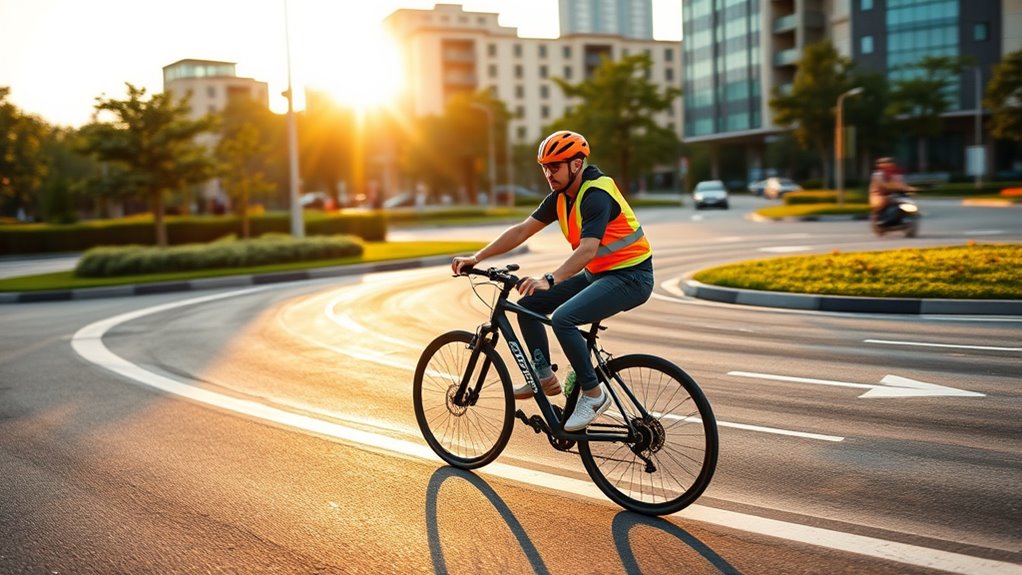

When approaching a roundabout on your bike, check traffic signs and lane markings to choose the correct lane early. Slow down, signal your intentions clearly, and yield to circulating vehicles, just like at busy intersections. Keep steady speed, stay in your lane, and avoid sudden movements. Signal before you exit and use hand signals to communicate with other road users. Following these guidelines helps you navigate smoothly—continue to learn more safe tips for cycling through roundabouts.
Key Takeaways
- Approach the roundabout slowly, signaling your intentions clearly to other road users.
- Use lane markings and signs to choose the correct lane for your intended exit.
- Yield to traffic already circulating, maintaining a safe speed and position.
- Signal when changing lanes or exiting the roundabout to communicate with drivers.
- Stay alert for pedestrians, cyclists, and vehicles, and navigate smoothly while maintaining lane discipline.

Have you ever wondered how to safely steer a roundabout on your bike? It’s a common concern, especially with busy intersections designed to keep traffic flowing smoothly. The key lies in understanding how to interpret signal timing and lane markings, which guide you through the roundabout efficiently and safely. When approaching, pay close attention to traffic signs indicating the correct lane to use. Lane markings are your primary visual cues, showing whether you should be in the left, middle, or right lane. These markings help you position yourself correctly before entering the roundabout, reducing confusion and preventing last-minute lane changes. If there are multiple lanes, choose the one that aligns with your intended exit. For example, if you plan to turn right or go straight, stay in the right lane; if you’re taking a left or making a full circle, the left lane is usually appropriate.
As you approach the roundabout, slow down and look for any signals from approaching vehicles. Signal timing plays a vital role here. Many drivers will use their turn signals to indicate their intentions, but it’s essential not to rely solely on them. Instead, observe the flow of traffic and lane markings to determine when it’s safe to enter. When entering, yield to traffic already circulating in the roundabout, just like you would at a busy intersection, but be extra cautious of vehicles and pedestrians. Keep your speed moderate, so you can react quickly if someone doesn’t follow the rules.
Once inside the roundabout, maintain your lane and keep an eye on the lane markings. These markings often help you stay centered and prevent you from drifting into other lanes or onto the sidewalk. If you need to change lanes within the roundabout, signal clearly and wait for a safe gap in traffic. When approaching your exit, use your hand signals to communicate your intention to other road users. Signal timing becomes especially important here, as other drivers and cyclists will be watching your cues to anticipate your move. Exit smoothly, maintain your lane, and continue to observe your surroundings.
Throughout the entire process, staying alert and aware of lane markings and signal timing is vital. They’re your best tools for steering a roundabout by bike confidently and safely. Proper understanding of signal timing and lane markings enhances your ability to navigate efficiently. With practice, understanding these visual cues and using proper signaling will become second nature, making your ride through roundabouts less stressful and more efficient.

Hcikoat Bike Tail Light with Turn Signals USB Rechargeable Bike Turn Signals 120 Lumens Ultra Bright LED Turn Signals for Bicycle 5 Mode with 10PCS Safety Reflective Tape for Cycling Electronics
- Ultra-Bright LED Lights: 120 Lumens with 32 SMD LEDs
- Weatherproof Design: IPX4 Waterproof for all conditions
- Multiple Lighting Modes: 5 modes including turn signals and flashing
As an affiliate, we earn on qualifying purchases.
As an affiliate, we earn on qualifying purchases.
Frequently Asked Questions
Are There Specific Safety Gear Recommendations for Cycling Through Roundabouts?
You should prioritize helmet safety and wear a well-fitted helmet to protect your head in case of falls or accidents. Additionally, use reflective gear, like vests or strips, to increase visibility to drivers, especially during low-light conditions. Consider wearing gloves and eye protection for added safety. By combining helmet safety with reflective gear, you enhance your safety and visibility when cycling through roundabouts, making your ride safer and more confident.
How Do Weather Conditions Affect Bike Navigation in Roundabouts?
Think of weather as a hidden opponent in your roundabout journey. Rain, fog, or snow impact your visibility challenges and make navigation trickier. You’ll need to slow down, stay alert, and use reflective gear to stand out. Wet surfaces reduce traction, so give yourself extra space and avoid sudden moves. Adjusting to weather conditions keeps you safe, ensuring you stay on course despite nature’s unpredictable influence.
Can Children Safely Navigate Roundabouts on Bikes?
Children can safely navigate roundabouts on bikes if they receive proper bike training and are supervised by an adult. Make sure they understand bike rules, practice in safe environments first, and stay alert. Supervision helps prevent accidents, especially when they’re learning. Enroll them in bike training programs to build skills and confidence. Always accompany young children and guide them through complex intersections like roundabouts until they’re ready to ride independently.
What Are Common Mistakes to Avoid When Biking in Roundabouts?
Imagine yourself entering a swirling dance floor; avoid common mistakes by not darting unpredictably or staying in the wrong lane. Keep your lane positioning consistent, staying to the right unless signs say otherwise. Use clear signaling techniques when you plan to exit or change lanes, ensuring drivers and cyclists understand your intentions. By doing so, you stay visible, predictable, and safe amid the spinning flow of the roundabout.
Are There Legal Differences in Bike Roundabout Rules Across Regions?
Regional variations exist in bike roundabout rules, so you need to check local laws to confirm legal compliance. In some areas, bikes are required to yield like vehicles, while others give cyclists priority. Always observe posted signs and local signage, as rules can differ considerably. Staying informed about regional variations helps you navigate safely and legally, preventing fines or accidents. When in doubt, prioritize safety and err on the side of caution.

8×12 Inch Metal Bicycle Direction Arrow Guide Sign, Non-motor Vehicle Route Plaque for City Street Community Cycle Lane
- Material: Rust-proof aluminum construction
- Size: 8×12 inches for clear visibility
- Weather Resistance: Resists rust, bending, and harsh weather
As an affiliate, we earn on qualifying purchases.
As an affiliate, we earn on qualifying purchases.
Conclusion
Mastering roundabouts on your bike might just be the ultimate superhero move. With these tips, you’ll glide through them faster than a speeding bullet, dodging cars and confusion effortlessly. Soon, you’ll conquer roundabouts like a cycling legend, leaving drivers in awe of your skill. Remember, every successful ride boosts your confidence to superhero levels—so get out there and show those roundabouts who’s boss! Your epic biking adventures are just a spin away.

WITTKOP Bike mirror | Large HD field of vision | 360° rotatable & foldable | Mounting above & below | Break-proof & durable | ebike accessories, bike mirror handlebar mount, bicycle mirrors
- Clear HD Field of Vision: Large convex real glass mirror
- 360° Adjustable: Full rotation and tilting capability
- Durable & Break-Resistant: Reinforced with over 20% stronger materials
As an affiliate, we earn on qualifying purchases.
As an affiliate, we earn on qualifying purchases.

UPXSXT 4Pcs Turn Signals for Bicycles with Alarm, USB Charging Remote Control Split/Integrated Bike Tail Light 5 Modes Waterproof Strobe Bike Rear Lights Can be Mounted on Front and Rear of Bicycle
- Remote Control with 5 Light Modes: Switches between turn, static, and strobe lights
- Flexible Installation Options: Can be integrated or separated for front or rear mounting
- Easy and Secure Mounting: Quick installation with firm grip on bike frame
As an affiliate, we earn on qualifying purchases.
As an affiliate, we earn on qualifying purchases.