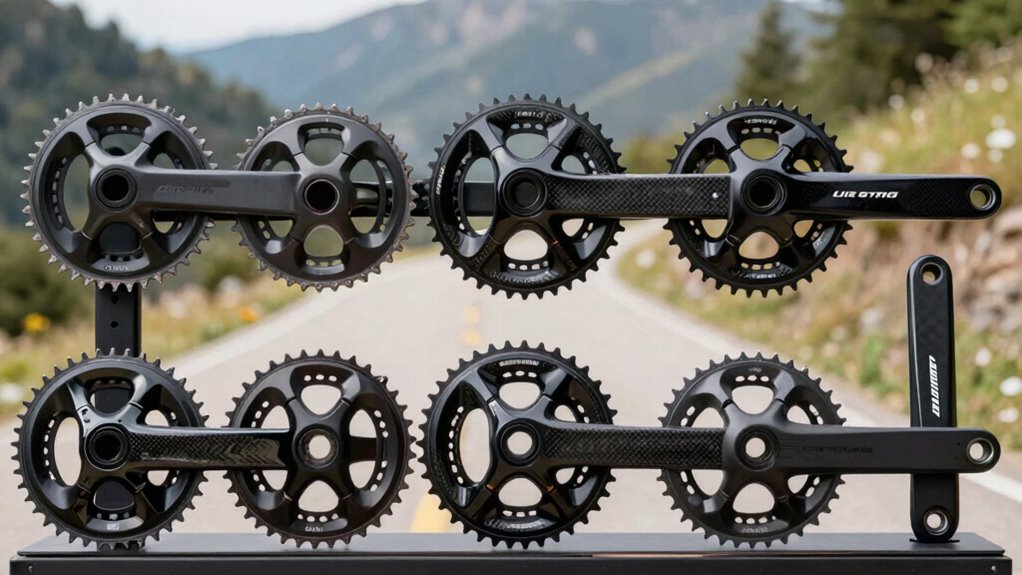

For carbon cranksets for road and gravel, my best overall pick is the SRAM Force DUB 12-Speed Crankset for its road-friendly double gearing and broad appeal across mixed-surface riding. The SRAM Force 1x XPLR AXS Power Meter Crankset stands out for gravel riders who want single-ring simplicity and integrated power data, while the SRAM Apex DUB Wide Crankset is a more approachable choice for a straightforward 1x build. The main tradeoffs are double versus single-ring gearing, electronic drivetrain compatibility, crank length, and whether power measurement is worth the extra complexity. Carbon construction can reduce weight, but it does not resolve fit or compatibility mismatches. Read on for the full breakdown and guidance on choosing a crankset that fits your bike and riding.

Get your wardrobe favorites delivered free with Prime
- Fast, free delivery on millions of items
- Prime Video, Amazon Music and more included
- Member-only deals all year
Key Takeaways
- The Force DUB 12-speed double is the broadest road-and-gravel fit: its two-ring format suits riders who want closer cadence choices and a wider range of road-style gearing.
- Force XPLR 1x models target gravel simplicity: their single-ring layouts reduce front-shifting needs, but riders must choose cassette range and chainring size carefully.
- Power measurement is a separate buying decision: the XPLR power-meter options add training data, while non-meter versions avoid paying for a feature some riders will not use.
- Crank length varies enough to affect the shortlist: listed options include 160, 165, 170, and 172.5 mm arms, so matching fit matters more than choosing carbon by default.
- The lineup is not uniformly carbon or equally suited to road use: the Claris FC-R2000 is an alloy-oriented 8-speed option, while the Apex and Force models serve different drivetrain and budget needs.
| SRAM Force DUB 12-Speed Crankset, 172.5mm, Iridescent Gray |  | Best for Fast Road Riding | Crank length: 172.5 mm | Chainrings: 50/37T | Material: Carbon fiber | VIEW ON AMAZON | See Our Full Breakdown |
| SRAM Force D2 Dub Crankset 172.5mm 46/33T Unicorn Grey |  | Best Carbon Pick for Mixed Road and Gravel | Crank length: 172.5 mm | Chainrings: 46/33T | Material: Carbon fiber | VIEW ON AMAZON | See Our Full Breakdown |
| SRAM Rival 1x XPLR AXS Wide Power Meter Crankset |  | Best for Gravel Power Tracking | Crank length: 170 mm | Crank arm material: Aluminum | Power meter: Spindle-based, left-side measurement | VIEW ON AMAZON | See Our Full Breakdown |
| Carbon Fiber Lightweight Modular Crankset for Road & Gravel Bikes |  | Best for Crank-Length and Ring-Size Choice | Material: T600 and T800 carbon fiber | Crank lengths: 165, 170, and 172.5 mm | Axle: 28.99 mm | VIEW ON AMAZON | See Our Full Breakdown |
| Shimano Claris FC-R2000 Crankset – 170mm, 8-Speed, 50/34t, 110 BCD, Hollowtech II Spindle Interface, Black |  | Best Entry-Level Replacement for 8-Speed Bikes | Crank length: 170 mm | Material: Aluminum | Drivetrain: 8-speed | VIEW ON AMAZON | See Our Full Breakdown |
| SRAM Force Carbon Crank Arm Set, 165 mm, 8-Bolt DUB |  | Best for Custom Builds | Material: Carbon fiber | Crank arm length: 165 mm | Interface: 8-bolt direct mount | VIEW ON AMAZON | See Our Full Breakdown |
| SRAM Force 1x XPLR Wide Crankset |  | Best Complete Carbon 1x Pick | Crankarm material: Carbon fiber | Crank length: 165 mm | Chainring: 42T X-Sync aluminum | VIEW ON AMAZON | See Our Full Breakdown |
| SRAM Force 1x XPLR AXS Power Meter Crankset, 12/13-Speed, 160 mm, Carbon |  | Best for Short-Crank Power Tracking | Crankarm material: Carbon fiber | Crank length: 160 mm | Chainring: 42T X-Sync aluminum | VIEW ON AMAZON | See Our Full Breakdown |
| SRAM Force 1x XPLR AXS Power Meter Crankset, 165 mm, 42T | | Best for 165 mm Power-Meter Builds | Crankarm material: Carbon fiber | Crankarm length: 165 mm | Chainring: 42T aluminum, SRAM 8-bolt direct mount | VIEW ON AMAZON | See Our Full Breakdown |
| SRAM Apex DUB Wide Crankset, 165 mm, 40T |  | Best Durable Aluminum Alternative | Crankarm material: Aluminum | Crank length: 165 mm | Chainring: 40T X-SYNC direct mount | VIEW ON AMAZON | See Our Full Breakdown |
| carbon cranksets for road and gravel | Crank length | Material | Spindle | Chainring |
|---|---|---|---|---|
| SRAM Force DUB 12-Speed Cranks | 172.5 mm | Carbon fiber | — | — |
| SRAM Force D2 Dub Crankset 172 | 172.5 mm | Carbon fiber | DUB | — |
| SRAM Rival 1x XPLR AXS Wide Po | 170 mm | — | 28.99 mm DUB | 42T, direct mount, 8-bolt X-Sync |
| Carbon Fiber Lightweight Modul | — | T600 and T800 carbon fiber | — | — |
| Shimano Claris FC-R2000 Cranks | 170 mm | Aluminum | — | — |
| SRAM Force Carbon Crank Arm Se | — | Carbon fiber | — | — |
| SRAM Force 1x XPLR Wide Cranks | 165 mm | — | 28.99 mm DUB | 42T X-Sync aluminum |
| SRAM Force 1x XPLR AXS Power M | 160 mm | — | — | 42T X-Sync aluminum |
| SRAM Force 1x XPLR AXS Power M | — | — | 28.99 mm DUB | 42T aluminum, SRAM 8-bolt direct mount |
| SRAM Apex DUB Wide Crankset | 165 mm | — | 28.99 mm DUB Wide | 40T X-SYNC direct mount |
More Details on Our Top Picks
SRAM Force DUB 12-Speed Crankset, 172.5mm, Iridescent Gray
I’d shortlist this Force carbon crankset for riders who want a large top gear and closely spaced shifts on paved routes. Its 50/37T X-Range rings favor speed while retaining a smaller inner ring for climbs; compared with the 46/33T SRAM Force D2 Dub Crankset, this setup is taller and better suited to fast road riding than steep, loaded gravel. The carbon arms aim to keep weight down while providing a firm pedaling platform, and the DUB system ties the choice to compatible bottom-bracket parts. That compatibility is not universal, despite the listed hub standards. I’d also skip it for a simple 1x build: the Rival 1x XPLR AXS Wide Power Meter Crankset is the more relevant option there. The distinctive finish is a bonus, not a reason to overlook the gearing tradeoff.
Pros:- Carbon crankarms keep the build focused on low weight and stiffness.
- 50/37T X-Range gearing suits faster road riding.
- 12-speed design provides a broad range with relatively close gear progression.
- Iridescent gray finish gives the crankset a distinctive appearance.
Cons:- The 50/37T gearing is less climbing-friendly than the 46/33T SRAM Force D2 option.
- Requires compatible DUB and 12-speed drivetrain components.
- The listed hub-standard compatibility does not by itself confirm bottom-bracket or frame fit.
Best for: Road riders with a compatible 12-speed setup who prioritize fast cruising, close gear steps, and a 50T big ring.
Not ideal for: Gravel riders tackling steep climbs or carrying luggage, and buyers whose bottom bracket or drivetrain does not match the DUB 12-speed setup.
- Crank length:172.5 mm
- Chainrings:50/37T
- Material:Carbon fiber
- Drivetrain:12-speed
- Model:Force Crankset D2
- Finish:Iridescent gray
- Listed hub standards:135/142 mm road disc; 141/148 mm Boost
Our verdict“Choose this Force crankset for fast road miles and a 50T top gear, but pick the 46/33T Force D2 for more climbing-focused road and gravel use.”
SRAM Force D2 Dub Crankset 172.5mm 46/33T Unicorn Grey
Among the two Force double-chainring choices here, I’d place the 46/33T Force D2 ahead for riders who split time between pavement and rougher routes. Its smaller rings give up some top-end gearing compared with the 50/37T SRAM Force DUB 12-Speed Crankset, but make steep grades and slower gravel climbs easier to manage. Carbon arms, a DUB spindle, and direct-mount rings bring a modern 12-speed package without the single-ring limitation of the SRAM Rival 1x XPLR AXS Wide Power Meter Crankset. The tradeoff is component matching: the crankset needs a compatible bottom bracket and drivetrain, and the product information does not specify a chainline or Q-factor to settle every fit question. I’d choose it for a versatile double setup, not for a casual bike where the added system requirements offer little benefit.
Pros:- 46/33T rings offer more climbing-friendly gearing than the 50/37T Force option.
- Carbon arms keep the crankset aligned with a lightweight performance build.
- Direct-mount chainrings and DUB spindle form a current SRAM 12-speed system.
- Listed compatibility covers several common road and Boost hub standards.
Cons:- Requires a compatible bottom bracket and drivetrain.
- Smaller 46T big ring gives up some high-speed gearing compared with the 50/37T Force crankset.
- The supplied specs do not state chainline or Q-factor for buyers checking precise frame fit.
Best for: Road and gravel riders with a compatible 12-speed DUB bike who want a carbon double and lower gearing for climbs.
Not ideal for: Casual riders seeking a straightforward replacement, or anyone who needs confirmed fit details beyond the listed hub standards before ordering.
- Crank length:172.5 mm
- Chainrings:46/33T
- Material:Carbon fiber
- Drivetrain:12-speed
- Spindle:DUB
- Chainring mounting:Direct mount
- Finish:Unicorn Grey
- Listed hub standards:135/142/141/148 mm
Our verdict“This is the more versatile carbon double for mixed road and gravel climbing, provided your bike already supports SRAM DUB 12-speed parts.”
SRAM Rival 1x XPLR AXS Wide Power Meter Crankset
I’d pick this crankset when power data and a 1x gravel setup matter more than carbon construction. Its spindle-based meter reads left-side power and calculates total watts, with ANT+ and Bluetooth LE support for compatible cycling computers and apps. The 42T X-Sync ring and 47.5 mm chainline are aimed at paved roads and unpaved trails, while the 150 mm Q-factor identifies a wide configuration that buyers should check against their fit preferences. Unlike both SRAM Force carbon doubles in this list, this model has aluminum arms; that is a clear material tradeoff, though it adds integrated measurement and stated 12- and 13-speed compatibility. The left-side estimate can differ from a dual-sided reading if a rider’s power balance is uneven, and the meter needs a battery. It is a focused tool, not a carbon-weight upgrade.
Pros:- Spindle-based meter provides left-side power measurement and calculates total watts.
- ANT+ and Bluetooth LE connect with compatible devices.
- Listed compatibility includes 12- and 13-speed drivetrains.
- 42T direct-mount X-Sync ring and 47.5 mm chainline suit the stated road and trail use.
Cons:- Aluminum arms do not meet the carbon-crankset brief as directly as either SRAM Force option.
- Power is measured on the left side only, so total output is an estimate.
- The power meter requires a battery-powered setup.
Best for: Gravel and road riders building a 1x 12- or 13-speed bike who want crank-based power data and wireless connectivity.
Not ideal for: Buyers specifically seeking carbon crankarms, a double-chainring setup, or independent left- and right-leg power measurements.
- Crank length:170 mm
- Crank arm material:Aluminum
- Power meter:Spindle-based, left-side measurement
- Chainring:42T, direct mount, 8-bolt X-Sync
- Drivetrain compatibility:12- and 13-speed
- Spindle:28.99 mm DUB
- Q-factor:150 mm
- Chainline:47.5 mm
- Connectivity:ANT+ and Bluetooth LE
Our verdict“Choose this for a 1x road or gravel bike where integrated power data matters more than carbon arms or dual-sided measurement.”
Carbon Fiber Lightweight Modular Crankset for Road & Gravel Bikes
This modular option stands out for its range of crank lengths and chainring configurations, rather than for a defined electronic drivetrain ecosystem. The listed 165, 170, and 172.5 mm lengths let a buyer match crank length to fit more closely than the fixed-length Force and Rival options here. It also offers gravel singles and road doubles, so one product family can suit very different gearing needs. At a stated 385 g ±5 g, it supplies a concrete weight figure, but the description’s broad compatibility claim is not backed by a named drivetrain standard or detailed interface list. That makes fit verification a bigger part of the decision than with SRAM’s specified DUB models. The modular design may help with service and configuration, yet assembly can call for specific tools. I’d choose it for configuration flexibility, not for buyers who want a clearly documented brand-matched system.
Pros:- Three listed crank lengths support a more tailored fit choice.
- Gravel 40T, 42T, and 44T options and several road double combinations cover varied gearing needs.
- Modular construction is intended to support assembly, disassembly, and maintenance.
- Stated weight is 385 g ±5 g.
Cons:- Specific drivetrain and interface compatibility is not fully detailed in the supplied information.
- Assembly or disassembly may require specific tools.
- The broad configuration range requires buyers to confirm the selected crank and ring combination fits their bike.
Best for: Road or gravel riders who want to select among several crank lengths and ring configurations and can verify their frame and drivetrain interfaces.
Not ideal for: Buyers who need explicit compatibility with a named drivetrain or prefer a well-documented plug-and-play crankset such as the SRAM Force D2.
- Material:T600 and T800 carbon fiber
- Crank lengths:165, 170, and 172.5 mm
- Axle:28.99 mm
- Q-factor:152 mm
- Weight:385 g ±5 g
- Gravel chainrings:40T, 42T, or 44T
- Road chainrings:50/34T, 52/36T, or 53/39T
- Design:Modular, reinforced keel
Our verdict“Pick this modular crankset for its choice of lengths and gearing, but only after confirming the exact interface and drivetrain fit with the seller or manufacturer.”
Shimano Claris FC-R2000 Crankset – 170mm, 8-Speed, 50/34t, 110 BCD, Hollowtech II Spindle Interface, Black
The Shimano Claris FC-R2000 is the practical outlier in this carbon-focused group: it uses aluminum, but it makes sense for riders maintaining an 8-speed road, touring, or hybrid bike. Its 50/34T double gives more top-end gearing than the 42T SRAM Rival 1x XPLR AXS Wide Power Meter Crankset, while the familiar Hollowtech II interface and 110 mm BCD define a straightforward system for matching compatible parts. Hyperglide shifting is intended to keep front shifts reliable with the corresponding setup. Compared with the carbon SRAM Force models, this is a simpler, older-speed choice—not a lightweight performance upgrade for a modern 12-speed gravel build. Its 43.5 mm chainline and stated 130/135 mm hub spacing help identify the intended fit, but buyers still need to match the frame and drivetrain.
Pros:- 50/34T double suits road riding and touring with a broad range of gears.
- Hollowtech II spindle interface and 110 mm BCD clearly identify the required crank system.
- Hyperglide design supports smooth shifting with a compatible 8-speed drivetrain.
- Aluminum construction is a practical match for replacement use on an older bike.
Cons:- Aluminum construction does not offer the carbon build sought elsewhere in this roundup.
- Designed for 8-speed drivetrains, limiting use with modern 12- and 13-speed systems.
- The road-oriented double setup is less suited to riders seeking a dedicated gravel 1x configuration.
Best for: Riders replacing a worn crankset on a compatible 8-speed road, touring, or hybrid bike who want a conventional double-ring setup.
Not ideal for: Modern 12- or 13-speed road and gravel builds, or buyers whose main goal is carbon construction and lower crankset weight.
- Crank length:170 mm
- Material:Aluminum
- Drivetrain:8-speed
- Chainrings:50/34T
- BCD:110 mm
- Spindle interface:Hollowtech II
- Chainline:43.5 mm
- Listed hub spacing:130 and 135 mm
Our verdict“Choose the Claris FC-R2000 to replace a compatible 8-speed road or touring crankset, not as an upgrade for a modern carbon gravel build.”
SRAM Force Carbon Crank Arm Set, 165 mm, 8-Bolt DUB
This is the most modular choice here: carbon 165 mm arms give you a lightweight base, while the 8-bolt interface lets you pair them with a compatible SRAM AXS spider or integrated chainring. That makes it a better fit for riders who already have a drivetrain plan than the complete Force 1x XPLR Wide Crankset, which arrives with a chainring ready for use. The DUB spindle interface offers broad frame compatibility, but it does not mean every bottom bracket or chainline will suit every build. The main tradeoff is what is absent: the spider and chainring are sold separately, adding parts-selection work and leaving the final setup dependent on your chosen components. I’d pick this set for a tailored road or gravel build, not for a quick, all-in-one replacement.
Pros:- Carbon fiber arms provide a lightweight crankarm option.
- 165 mm length suits riders who specifically want shorter crank arms.
- 8-bolt interface supports compatible SRAM AXS spiders and integrated chainrings.
- DUB spindle interface offers broad frame compatibility when paired with the correct bottom bracket.
Cons:- Spider and chainring are not included.
- Buyers must confirm chainline, chainring, and bottom-bracket compatibility before building.
Best for: Road and gravel builders who already own compatible SRAM AXS 8-bolt parts or want to choose their own spider and chainring.
Not ideal for: Riders seeking a complete crankset they can install without sourcing extra drivetrain components.
- Material:Carbon fiber
- Crank arm length:165 mm
- Interface:8-bolt direct mount
- Spindle interface:DUB
- Compatibility:SRAM AXS spiders and integrated chainrings
- Included drivetrain parts:Chainring and spider sold separately
- Model:Force Crank Arm Assembly E1
Our verdict“Choose this set if you want 165 mm carbon arms for a custom SRAM AXS build and are prepared to source the matching drivetrain parts.”
SRAM Force 1x XPLR Wide Crankset
For a rider who wants carbon arms and a ready-to-run single-ring setup without adding a power meter, this Force 1x XPLR Wide is the most direct match in this group. Its included 42T X-Sync chainring keeps the build simpler than the Force carbon arm set, which requires a separately purchased spider and ring. The 1x layout also removes front shifting, a practical advantage on mixed road and gravel routes where fewer drivetrain parts can mean fewer shifting decisions. It is listed for 12-speed use, so riders with a different drivetrain should check compatibility rather than assume it will fit. Compared with the power-meter XPLR options, this crankset skips training data in favor of a simpler setup. Its stated 900 g weight may also deter riders focused on minimizing every gram.
Pros:- Carbon fiber crankarms paired with an included 42T chainring.
- 1x layout removes front shifting and simplifies the drivetrain.
- X-Sync tooth profile is designed to support chain retention.
- Listed as compatible with 135 mm and 142 mm road disc hubs.
Cons:- Listed as a 12-speed crankset, limiting drivetrain compatibility.
- The single-ring setup gives up front shifting and its wider gear-range options.
- The stated 900 g weight may not suit riders prioritizing a very light build.
Best for: Road and gravel riders building a compatible 12-speed 1x drivetrain who want carbon arms and an included 42T ring without power-meter hardware.
Not ideal for: Riders who need front shifting, a different speed configuration, or a crankset built around power measurement.
- Crankarm material:Carbon fiber
- Crank length:165 mm
- Chainring:42T X-Sync aluminum
- Mount:SRAM 8-bolt direct mount
- Spindle:28.99 mm DUB
- Drivetrain:12-speed
- Road disc hub compatibility:135 mm and 142 mm
- Stated item weight:900 g
Our verdict“Pick this complete carbon 1x crankset if your 12-speed road or gravel setup suits a 42T ring and you do not need a power meter.”
SRAM Force 1x XPLR AXS Power Meter Crankset, 12/13-Speed, 160 mm, Carbon
This version pairs a 160 mm carbon crankset with an integrated spindle-based power meter, making it the standout here for riders who want shorter arms and ride data in one setup. Its stated 12- and 13-speed compatibility gives it a broader listed range than the non-meter Force 1x XPLR Wide, which is specified for 12 speeds. Left-side measurement calculates total power, a useful training estimate, though it is not the same as measuring both legs independently. The 42T X-Sync ring and 47.5 mm chainline suit a wide 1x gravel arrangement, but the ring interface still needs to match the SRAM 8-bolt system. Compared with the 165 mm Force power-meter crankset, this model is the shorter-arm choice; riders who need bilateral power or a different crank length should look elsewhere.
Pros:- 160 mm carbon arms suit riders specifically seeking shorter crank length.
- Spindle-based meter measures left-side power and calculates total watts.
- Listed compatibility covers 12- and 13-speed drivetrains.
- IPX7 protection and more than 400 hours of stated battery life support regular outdoor use.
Cons:- Power is measured on the left side rather than independently on both sides.
- Requires a compatible SRAM 8-bolt direct-mount chainring.
- The listed 3.5 lb weight may concern riders building for minimum mass.
Best for: Gravel and road riders who prefer 160 mm cranks, want onboard power tracking, and use a compatible 12- or 13-speed SRAM 1x drivetrain.
Not ideal for: Riders who need independent left- and right-leg power data, a different crank length, or a non-SRAM 8-bolt chainring setup.
- Crankarm material:Carbon fiber
- Crank length:160 mm
- Chainring:42T X-Sync aluminum
- Drivetrain compatibility:12- and 13-speed
- Spindle diameter:28.99 mm
- Chainline:47.5 mm
- Power measurement:Left-side measurement; calculates total watts
- Battery life and protection:400+ hours; IPX7 waterproofing
Our verdict“Choose this model if 160 mm arms and integrated power data matter more than bilateral measurement or a lighter stated weight.”
SRAM Force 1x XPLR AXS Power Meter Crankset, 165 mm, 42T
Compared with the 160 mm XPLR power-meter model, this crankset keeps the same basic idea—a carbon 1x setup with left-side power measurement—but uses 165 mm arms. That makes it the more natural match for riders already settled on that length, while still adding ANT+ and Bluetooth LE connections for compatible cycling computers and training devices. The included 42T aluminum ring and 47.5 mm chainline are aimed at SRAM’s wide gravel arrangement, and the stated 12- and 13-speed support gives it flexibility within that system. Its limits are practical rather than hidden: power is estimated from the left side, and the DUB bottom bracket is not included. I’d favor this over the non-meter Force 1x XPLR Wide only when training data justifies the extra system complexity.
Pros:- Carbon 165 mm arms come with a 42T direct-mount chainring.
- ANT+ and Bluetooth LE support connection to compatible devices.
- Left-side power measurement calculates total wattage.
- Stated battery life exceeds 400 hours, with a user-replaceable AAA lithium battery.
Cons:- Power is measured on the left side only.
- DUB bottom bracket is sold separately.
- The 47.5 mm chainline and 8-bolt ring mount require a compatible drivetrain setup.
Best for: Riders who use 165 mm cranks, want power data for road and gravel training, and have a compatible SRAM 12- or 13-speed 1x setup.
Not ideal for: Riders who want bilateral power readings, need a bottom bracket included, or prefer 160 mm cranks.
- Crankarm material:Carbon fiber
- Crankarm length:165 mm
- Chainring:42T aluminum, SRAM 8-bolt direct mount
- Spindle:28.99 mm DUB
- Drivetrain compatibility:12- and 13-speed
- Chainline and Q-factor:47.5 mm; 150 mm
- Connectivity:ANT+ and Bluetooth LE
- Bottom bracket:Not included
Our verdict“Choose this if you want a 165 mm carbon XPLR crankset with onboard power measurement and already have a compatible bottom bracket and drivetrain.”
SRAM Apex DUB Wide Crankset, 165 mm, 40T
This is the clear outlier for buyers who value a practical gravel drivetrain more than carbon construction. The aluminum arms distinguish it from the Force options, while the 40T X-SYNC ring and 47.5 mm chainline are aimed at chain security and tire clearance on rougher routes. Compared with the carbon Force 1x XPLR Wide and its 42T ring, the Apex gives up carbon and two teeth up front, which can suit riders who want a simpler, more trail-friendly setup rather than a faster top gear. Its stated compatibility includes 135 mm, 142 mm, and Boost spacing, though buyers still need to confirm their frame and drivetrain fit. The tradeoff is inherent to 1x: there is no front shifting, and 165 mm is the only listed crank length.
Pros:- Aluminum crankarms offer a durable alternative to the carbon Force cranksets.
- 40T X-SYNC direct-mount ring supports a simple single-ring setup.
- 47.5 mm chainline is specified to accommodate larger gravel tires.
- Listed rear hub spacing compatibility includes 135 mm, 142 mm, and Boost.
Cons:- Aluminum arms do not meet the carbon-focused brief as closely as the Force models.
- Single-ring gearing has no front shifting.
- Only a 165 mm crank length is listed.
Best for: Gravel and cyclocross riders who prioritize a durable aluminum 1x crankset, a 40T ring, and clearance for larger tires.
Not ideal for: Buyers set on carbon crankarms, front shifting, or a crank length other than 165 mm.
- Crankarm material:Aluminum
- Crank length:165 mm
- Chainring:40T X-SYNC direct mount
- Spindle:28.99 mm DUB Wide
- Chainline:47.5 mm
- Number of speeds:12
- Rear hub spacing compatibility:135 mm, 142 mm, and Boost
- Intended terrain:Cyclocross, mountain, and unpaved trails
Our verdict“Pick the Apex if durability, a 40T gravel ring, and wide-tire clearance matter more to you than carbon arms or front shifting.”
How We Picked
I ranked these cranksets by how well their stated format serves road and gravel riding, weighing gearing flexibility, drivetrain fit, crank-length choice, power-meter availability, and the likely demands of mixed terrain. A useful all-rounder should work for more than one narrow build, while a gravel-specific 1x crankset earns its place through simplicity and compatible wide-range gearing rather than pretending to suit every road setup.
Compatibility and clear use cases shaped the order as much as materials. Force options lead where they combine carbon construction with useful road or XPLR configurations; power-meter models rank higher for riders who can use their data, not as automatic upgrades for everyone. The Apex is included as a simpler entry point, the modular carbon crankset is harder to place without detailed fit and interface information, and the Claris is a budget-minded 8-speed alternative rather than a direct carbon peer. Before buying, verify the exact chainring, spindle, bottom bracket, chainline, and drivetrain compatibility for your bike.
| carbon cranksets for road and gravel | Material |
|---|---|
| SRAM Force DUB 12-Speed Cranks | Carbon fiber |
| SRAM Force D2 Dub Crankset 172 | Carbon fiber |
| SRAM Rival 1x XPLR AXS Wide Po | — |
| Carbon Fiber Lightweight Modul | T600 and T800 carbon fiber |
| Shimano Claris FC-R2000 Cranks | Aluminum |
| SRAM Force Carbon Crank Arm Se | Carbon fiber |
| SRAM Force 1x XPLR Wide Cranks | — |
| SRAM Force 1x XPLR AXS Power M | — |
| SRAM Force 1x XPLR AXS Power M | — |
| SRAM Apex DUB Wide Crankset | — |
Factors to Consider When Choosing Carbon Cranksets For Road And Gravel
Choosing a crankset starts with the bike and drivetrain, not the material label. These broader checks help prevent a costly mismatch and make it easier to decide whether a carbon upgrade, a different gearing format, or power measurement will make a real difference to your riding.
Match the Crankset to Your Drivetrain
Check the crankset’s speed designation, chainring format, mounting interface, and bottom-bracket standard against the parts already on your bike. A crank that physically fits the frame may still create shifting or chainline problems if its chainrings are intended for a different system. Electronic shifting and wide gravel setups can have specific compatibility requirements, so confirm the maker’s documentation rather than relying on a product title alone. Be especially careful with similarly named Force and XPLR versions: their intended gearing and configurations are not interchangeable by assumption. If you are changing the drivetrain at the same time, compare the full conversion cost and parts list before choosing a crank.
Choose 1x or 2x Around Your Routes
A 1x setup removes the front derailleur and makes gear changes simpler on rough terrain, but its jumps between gears can feel larger on steady road sections. A 2x system offers closer ratios and can better suit riders who alternate between fast pavement and varied climbs. Think about the steepest grades and fastest descents you regularly ride, then check whether the chainring and cassette combination covers both ends of that range. A common mistake is selecting a chainring based only on another rider’s setup without accounting for cassette range, wheel size, or fitness. If your routes span both road and gravel, prioritize the range you need most rather than expecting one combination to feel perfect everywhere.
Treat Crank Length as a Fit Choice
Crank length affects pedal-circle size, knee and hip movement, and clearance over obstacles; it is not merely a sizing detail. The options here range from 160 mm to 172.5 mm, so riders have room to compare lengths rather than defaulting to a familiar number. Shorter arms may help some riders maintain a comfortable position or reduce pedal strikes on rough trails, while a change in length can also alter preferred gearing and saddle setup. Do not assume a new crank length will feel identical with the same saddle height and riding position. If you are uncertain, use a fit recommendation or compare the proposed length with your current setup before ordering.
Decide Whether Power Data Justifies the Added Complexity
A power-meter crankset makes sense when you will use consistent power data for structured training, pacing, or progress tracking. If you ride mainly by feel or do not plan to review the data, a non-meter crankset can keep the setup simpler. Before purchasing, check whether the meter measures one side or both, what data it provides, how it is powered, and whether its software works with your head unit or training platform. Also confirm that the meter version is sold with the chainring and crank length you need; product names can conceal meaningful variations. Reserve part of your budget for setup and any required compatible components rather than focusing on the meter alone.
Compare Whole-System Cost, Not Carbon Alone
Carbon construction can lower weight, but it does not automatically improve shifting, fit, or reliability for a particular frame. A less expensive crankset that matches your drivetrain may be a better purchase than a carbon model that requires extra parts or compromises your gearing. Include the cost of a compatible bottom bracket, chainrings, power-meter components, and any tools or shop labor in your comparison. The Claris option in this roundup is an 8-speed alternative, not a direct material match for the carbon Force choices, so compare it for system compatibility and use rather than carbon status. Spend more when the upgrade provides a feature you will use, such as the gearing format, crank length, or power data you actually need.
Frequently Asked Questions
Can I use a road double crankset for gravel riding?
Yes, a road double can work well on gravel when its chainrings and cassette provide enough low gearing for your climbs. The closer ratios can be useful when your riding includes long paved sections or steady speeds. Check the crankset’s chainline and frame clearance, since gravel frames and wide rear setups can have different requirements from a road bike. If your routes are steep or rough and you prefer fewer shifting decisions, a 1x XPLR setup may suit you better. Compare the lowest gear on the complete drivetrain rather than judging the crankset by chainring size alone.
Should I choose a power-meter crankset or a standard crankset?
Choose a power-meter version if you have a clear plan to use power data for training, pacing, or evaluating progress. A standard crankset is the simpler choice when you mainly ride for recreation or prefer heart-rate and perceived-effort cues. Check the meter’s measurement design, battery or charging method, and compatibility with your recording device before committing. Also confirm the exact crank length and chainring configuration, since power-meter models may not offer every combination. Paying for measurement has little value if the data will not shape your training or riding decisions.
How do I know whether a crankset will fit my bike?
Verify the bottom-bracket interface, spindle standard, frame clearance, chainline, and drivetrain speed before ordering. A DUB spindle, for example, requires a compatible bottom-bracket arrangement; the crank’s name alone does not confirm that your frame is ready for it. Check chainring mounting and front-derailleur compatibility if you are buying a 2x model. For 1x, confirm that the chainring offset and tooth profile suit the frame and intended chainline. If any specification is unclear, compare the manufacturer’s fit documentation with your frame and existing components or ask a mechanic to check the build.
Is a 1x crankset a good choice for a bike used on both pavement and gravel?
It can be, especially when simplicity and a clean cockpit matter more than close gear spacing. The key compromise is that a 1x cassette often has larger jumps between gears, which some riders notice on flat roads or rolling pavement. Choose the chainring and cassette together so the lowest gear works on your steepest regular climb without making your fastest road gear feel limiting. A 2x setup may be more comfortable for riders who spend substantial time at steady road speeds. Your typical route mix should decide the format, not the assumption that one system is universally better.
Is the Claris FC-R2000 a suitable alternative to the carbon cranksets here?
The Claris FC-R2000 is an 8-speed crankset and is best treated as a drivetrain-specific option, not a like-for-like carbon upgrade. It may suit a compatible entry-level road build or a repair where matching the existing 8-speed system matters more than reducing crank weight. It will not serve as a direct replacement for a 12-speed Force or XPLR crankset without considering the rest of the drivetrain. Confirm its chainring, bottom-bracket interface, and frame fit before buying. Riders seeking a carbon crankset or a modern gravel 1x configuration should focus on the Force or Apex options instead.
Conclusion
For the broadest road-and-gravel use, I recommend the SRAM Force DUB 12-Speed Crankset as best overall, especially for riders who want a double-ring setup. The SRAM Apex DUB Wide Crankset is my best value and beginner-friendly pick for a straightforward 1x build, provided its gearing and compatibility match the bike. For a premium gravel setup with training data, choose a Force 1x XPLR AXS Power Meter Crankset in the crank length and chainring configuration that fits your needs. Riders who want gravel 1x without a meter should compare the non-meter Force XPLR crankset; those seeking close ratios for mixed pavement and dirt should favor a double. The Claris is best reserved for compatible 8-speed builds, while the modular carbon option calls for extra verification of its specifications before purchase.