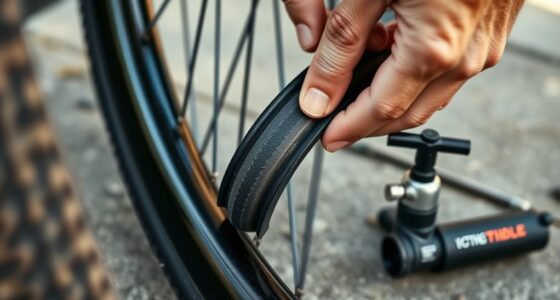
To dial in your tire pressure, start by checking your vehicle’s recommended PSI on the door jamb or manual. Use a reliable pressure gauge to measure each tire when they’re cold. Add air with an air compressor until each one hits the proper level. Regularly monitoring and adjusting your tires helps keep your vehicle safe, efficient, and tires lasting longer. If you want to master the simple steps for perfect tire pressure, keep exploring the essentials.
Key Takeaways
- Use a reliable tire pressure gauge to measure current pressure accurately.
- Locate the recommended pressure for your vehicle in the owner’s manual or door jamb sticker.
- Ensure tires are cold before checking for the most accurate reading.
- Attach the gauge firmly to the valve stem to get a precise measurement.
- Adjust tire pressure with an air compressor or pump until it matches the recommended level.

Have you ever wondered how maintaining the right tire pressure can improve your vehicle’s performance and safety? It’s one of those small adjustments that can make a significant difference. The key is understanding how to accurately measure and maintain the proper inflation levels. That’s where tire pressure gauges come into play. These handy tools are essential for checking your tires and ensuring they’re at the optimal inflation. Using a reliable tire pressure gauge isn’t complicated, but it does require a bit of knowledge to get the most accurate reading. When you check your tire pressure, you simply press the gauge onto the valve stem, making sure there’s a tight seal to prevent air from escaping. In just a few seconds, the gauge will give you a reading that indicates whether your tires are underinflated, overinflated, or at the correct pressure.
Knowing the optimal inflation for your tires is crucial. This information is usually found in your vehicle’s owner’s manual or on a sticker inside the driver’s side door jamb. Maintaining your tires at this recommended pressure ensures they wear evenly, improve fuel efficiency, and provide better handling. Underinflated tires can cause sluggish steering, poor fuel economy, and an increased risk of blowouts, especially at higher speeds. Overinflated tires, on the other hand, tend to have a harsher ride and may wear unevenly, reducing their lifespan. By regularly using your tire pressure gauges, you can keep your tires within the ideal range, promoting safety and extending tire life.
The process of dialing in the right tire pressure doesn’t have to be complicated or time-consuming. Make it a habit to check your tires once a month and before long trips. Always do this when the tires are cold, as heat from driving can temporarily increase the pressure and give you a false reading. When you find your tires are not at the optimal inflation, adjust the air pressure using an air compressor or a pump. Add air if they’re underinflated, or release some if they’re overinflated, until you reach the recommended pressure. Consistently monitoring and maintaining proper tire pressure is a simple but vital step in ensuring your vehicle runs smoothly, safely, and efficiently. It’s a small effort that delivers big benefits, helping you avoid breakdowns and costly repairs down the road.
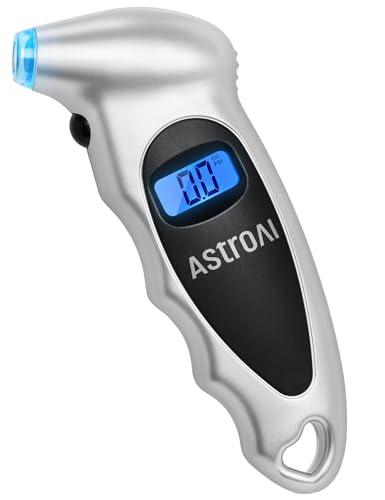
AstroAI Digital Tire Pressure Gauge 150PSI, ±1PSI Accuracy for Car Truck
- Accurate, Factory-Calibrated Readings: ±1 PSI accuracy for reliable results
- Backlit LCD & Nozzle Light: Illuminated display and nozzle for dark conditions
- Multiple Measurement Units: Switch between PSI, Bar, Kgf/cm², KPA easily
As an affiliate, we earn on qualifying purchases.
As an affiliate, we earn on qualifying purchases.
Frequently Asked Questions
How Often Should I Check My Tire Pressure?
You should check your tire pressure at least once a month to ensure ideal Tire pressure maintenance. Additionally, perform seasonal tire checks, especially before winter and summer, because temperature changes affect pressure. Regularly monitoring your tires helps improve fuel efficiency, safety, and tire longevity. Don’t forget to check when tires are cold for the most accurate readings. Making this a routine will keep your vehicle running smoothly and safely year-round.
Can Temperature Affect My Tire Pressure Readings?
Yes, temperature variability can affect your tire pressure readings. As temperatures drop, air contracts, leading to pressure fluctuations, and when it warms up, air expands, increasing pressure. You should check your tire pressure regularly, especially during temperature changes, to guarantee safe and ideal driving conditions. Keep in mind that a 10-degree Fahrenheit change can alter tire pressure by about 1 psi, so monitor accordingly.
What Tools Are Best for Measuring Tire Pressure Accurately?
Think of your tire pressure tools as your car’s health check-up. Digital gauges offer quick, precise readings with easy-to-read screens, making them ideal for everyday use. Analog meters, with their classic dial, give a reliable, hands-on feel, perfect for those who prefer a tactile experience. Both are accurate, but your choice depends on whether you value speed and modernity or tradition and simplicity. Trust your instincts and keep your tires in top shape!
How Do I Adjust Tire Pressure for Different Loads?
To adjust tire pressure for different loads, you need to perform load specific inflation. First, check your vehicle’s recommended tire pressure for varying loads, usually found on the driver’s door or in the owner’s manual. Use a reliable tire pressure gauge to measure current pressure. Then, add or release air accordingly, ensuring you match the recommended pressure for your load. Proper tire pressure adjustment enhances safety, tire longevity, and fuel efficiency.
What Are Signs of Overinflated or Underinflated Tires?
You’ll notice overinflated tires have a center tread wear pattern, while underinflated tires show more wear on the edges. Both affect fuel efficiency—overinflation reduces traction, and underinflation increases rolling resistance. Keep an eye on tire wear patterns and listen for thumping sounds or vibrations. Properly inflated tires improve safety, extend lifespan, and boost fuel economy, so check your tire pressure regularly to avoid these signs.

OlarHike Tire Inflator Portable Air Compressor, Dual Power-3 * 2000mAh & 12V DC
- Fast Inflation for Tires: Inflates a car tire in 55 seconds
- Dual Power Options: Cordless and car cigarette lighter modes
- High-Capacity Battery: 6000mAh for multiple tire top-offs
As an affiliate, we earn on qualifying purchases.
As an affiliate, we earn on qualifying purchases.
Conclusion
Keeping your tire pressure dialed in is simple and vital for safety and efficiency. Just like they say, “A stitch in time saves nine,” checking your tires regularly prevents bigger problems down the road. Don’t wait until you’re stranded or your fuel economy drops; make it a habit. With a little effort now, you’ll enjoy a smoother ride and save money in the long run. Stay proactive, and your tires will thank you!

AstroAI AIRUN H Tire Inflator Portable Air Compressor, 12V DC Tire Inflator, Auto Shut-Off with Digital Pressure Gauge & LED Light, Fast Inflation for Car, Motorcycle, Bike Tires, 9.8Ft Cord, Yellow
- Power Source: Requires 12V DC cigarette lighter
- Cord Length: 9.8-foot power cord
- Inflation Control: Programmable pressure with auto shut-off
As an affiliate, we earn on qualifying purchases.
As an affiliate, we earn on qualifying purchases.

ETENWOLF Tire Pressure Gauge for Cars 0-75 PSI with Large Glow Dial
- Calibration Standard: Calibrated to ANSI B40.1 Grade A
- Pressure Range: Measures 0-75 PSI
- Glow Dial: Large glow dial for night reading
As an affiliate, we earn on qualifying purchases.
As an affiliate, we earn on qualifying purchases.